






World Digestive Health Day
On May 29, 1958, Dr. Henry Cohen, founder of the World Gastroenterology Organisation, proposed the establishment of a "World Digestive Health Day". In 2005, WGO researchers brought together gastrointestinal scholars from around the world for the first Gut Health Symposium and decided to designate May 29 every year as World Gut Health Day.
This year is the 18th "World Digestive Health Day". Only healthy intestines can be healthy! Hehe, Biology wishes all friends, have a healthy gut, and enjoy a happy life!
Every year, the World Organization for Gastroenterology selects a specific theme for World Digestive Health Day, with the last two themes being viral hepatitis and obesity. And this year, in order to draw people's attention to colorectal cancer, WGO set the theme as "Colorectal Cancer Prevention: Getting Back on Track", that is, "Colorectal Cancer Prevention: Getting Back on Track".
According to the World Cancer Report 2020, colorectal cancer is the third most common cancer in the world, with 1.8 million new cases in 2018. It is also cancer with the second highest mortality rate, with 880,000 deaths in the same year. Recently, the National Cancer Center of my country published China's latest cancer report "2016 Cancer Incidence and Mortality in China" in the Journal of the National Cancer Center (JNCC). It has become one of the major cancers that endanger life and health.
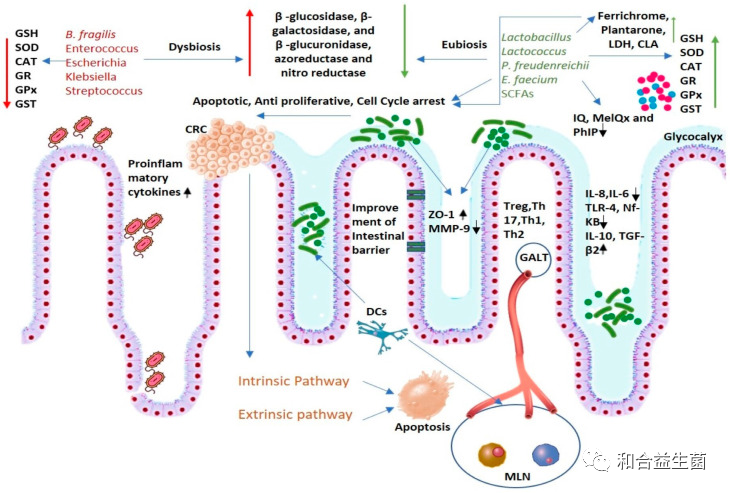
Studies have confirmed that probiotics can prevent colorectal cancer through a series of mechanisms. Typically, these complex mechanisms, by exerting positive effects on the gut microbiota, protect the colorectum from environmental stressors that predispose it to carcinogenesis. The main mechanisms include the establishment of the intestinal ecological environment, the improvement of intestinal barrier function, the regulation of the intestinal immune system, the production of anticancer compounds, and the degradation of carcinogens in the intestinal environment.
01 Limit the growth of cancer cells
Probiotics can inhibit the growth of cancer cells by inducing apoptosis. The pro-apoptotic effect of probiotics has been demonstrated in many in vitro experiments, usually accompanied by the expression or inhibition of apoptosis-related proteins. At the same time, probiotics can regulate host intestinal immunity by synthesizing short-chain fatty acids (such as butyric acid, propionic acid, and acetic acid), reduce the colonic inflammatory response, inhibit colon tumor cell proliferation, induce tumor cell differentiation and apoptosis, and affect proto-oncogenes. Express.
02 Regulate micro-ecological balance and health
The host's intestinal flora is mainly composed of Firmicutes, Actinobacteria, Bacteroidetes, and Proteobacteria. Among them, Firmicutes mainly include Clostridium, Bacteroidetes, Bifidobacterium, Enterobacteriaceae, and Lactobacillus, among which, Bifidobacterium long in the Bifidobacterium family is the most abundant species. In contrast, the intestinal flora of patients with colorectal cancer was significantly different from that of healthy hosts, with significantly reduced butyrate-producing bacteria, while Enterococcus, Escherichia coli/Shigella, Klebsiella, Streptococcus Genus, and Gastric Streptococcus are more common in patients with colorectal cancer.
The composition of gut microbiota is a key factor affecting the treatment of colorectal cancer. By using probiotics and prebiotics to rebalance the intestinal micro-ecosystem, it can effectively inhibit pathogenic microorganisms, help the growth of beneficial bacteria in Harajuku, regulate the immune response and repair the intestinal mucosa, thereby affecting the development of cancer.
03 Strengthen the intestinal barrier
Human intestinal epithelial cells protect the internal environment from pathogens, toxic substances, and stress factors. Their paracellular and extracellular permeability regulates the transfer of water, ions, and nutrients and limits the transfer of harmful substances. Gut barrier function is regulated by immune cells. Probiotics can enhance intestinal barrier function by secreting short-chain fatty acids and repairing damaged intestinal epithelial cells, thereby limiting the process of cancer invasion and metastasis.
04 Produce anti-cancer substances
Anticancer substances are biologically active compounds that inhibit the development of cancer or neutralize carcinogenic compounds. Probiotics can prevent the development of cancer by secreting these compounds. In addition to short-chain fatty acids, probiotics can also produce bioactive substances such as conjugated linoleic acid and iron pigment, which have cytotoxic effects on cancer cells.
05 Degradation of carcinogens
Metabolic enzymes produced by gut microbiota frequently convert different precursor compounds into carcinogens. Studies have found that different carcinogenic factors in food can lead to colon cancer. The production of mutagenic and carcinogenic compounds can be indirectly controlled by regulating the expression of enzymes in different gut microbes. Probiotics can reduce their carcinogenic effects by binding to carcinogens or by reducing the activity of compounds
Star strains, protect the health
01 Lactobacillus casei PB-LC39, Lactobacillus plantarum HH-LP56, Lactobacillus acidophilus HH-LA26
China Patent No.: ZL 202010306925.4
Using the aforementioned Lactobacillus casei PB-LC39, Lactobacillus Plantarum HH-LP56, Lactobacillus acidophilus HH-LA26, together with Saccharomyces cerevisiae and Acetobacter pasteuri, the anti-alcoholic, detoxifying and liver-protecting probiotics formula can be taken before drinking, Take after drinking, solve liver poisoning caused by ammonia after drinking or solve liver poisoning caused by acetaldehyde after drinking, it can also be used to prepare to take before drinking, taking after drinking, solving liver poisoning caused by ammonia after drinking or solving the cause The probiotic health food for liver poisoning caused by acetaldehyde after drinking has a good anti-alcoholic effect and no toxic side effects.
02 Lactobacillus rhamnosus PB-LR76, Lactobacillus reuteri PB-LR09, Bifidobacterium lactis HH-BA68
China Patent No.: ZL 201910895017.0
The aforementioned Lactobacillus rhamnosus PB-LR76, Lactobacillus reuteri PB-LR09, and Bifidobacterium lactis HH-BA68 are used to form a probiotic formula for improving female vaginitis. Probiotic health food, applied to improve female bacterial vaginitis (BV) and fungal vaginitis (VVC), improve bacterial vaginitis (BV) effect ≥ 70%, improve fungal vaginitis (VVC) Impact by≥ 60%.
03 Lactobacillus plantarum HH-LP78 Patent publication number: CN114259055A
The invention discloses a composition for antagonizing Helicobacter pylori, which comprises Lactobacillus Plantarum HHLP78 components and roselle plant essential oil components; According to the principle of "biological occupation, compound antagonism", it can eliminate Helicobacter pylori in the human stomach. It has been tested in clinical trials of the test population, and the statistical clearance rate is ≥53%. It has a wide range of application prospects in the prevention and treatment of Helicobacter pylori infection.
04 Lactobacillus helveticus HH-LPH17 Patent publication number: CN114262671A
The present invention provides a strain of Lactobacillus helveticus HH-LPH17 isolated from traditional dairy products, and the Lactobacillus helveticus strain is preserved in the China Center for Type Culture Collection, and the preservation number is CCTCCNO: M2021725. The Lactobacillus helveticus has good gastric acid tolerance, bile salt tolerance, and strong cell adhesion ability; has good storage stability, can effectively inhibit the accumulation of bile acids in the liver, and inhibit the increase of serum transaminase levels. It has a good application prospect in the prevention and treatment of cholestatic liver disease.
05 Lactobacillus johnsonii LBJ456® US Patent No.: US 10,028,983 B2
Lactobacillus johnsonii LBJ456® has good stomach acid and bile salt tolerance and cell adhesion, can colonize the human intestine for more than 60 days and is resistant to Salmonella, Escherichia coli, Enterococcus faecalis, Typhimurium Salmonella and other pathogenic bacteria have a good inhibitory effect, reducing the activity of carcinogen synthases such as chlororeductase, glucuronidase, nitrate reductase, etc. produced by these spoilage bacteria, thereby reducing the production of carcinogens; In addition, It can also reduce genotoxicity and genomic instability through its anti-inflammatory effects, with significant improvements in prolonging life expectancy and delaying cancer onset.